


Pause for some exciting news before you dive into today’s article. Our brand new VDI babies are now out in the world!
One is the AI Developmental Lab - the first AI companion with vertical development at the core for coaches, learning designers and leaders.
The other is the Group Deliberation Inventory GDI® - the first tool to measure how a team reasons together through a complex problem in real time, applying a vertical development lens and using AI alongside psychometrics and human facilitators to gain insights into the group dynamics. Pilot workshops are taking place now - bring your team along and let’s learn together (more details on the GDI® main page)!
Who would you be if you weren’t … fill in the blanks here with the role you have identified most in your life. And notice what you feel. Do you feel your heart contracting? A pang of anxiety? Or perhaps a sneaky sense of freedom?
Who would you be if you weren’t the expert? The parent? The successful corporate executive? The entrepreneur? The rational one in every conversation? The one in control? The teacher? The caretaker? The smart one? The go-getter? The peace-maker? The doer? The always good, always helpful one? The responsible one? The breadwinner? The nurturer?
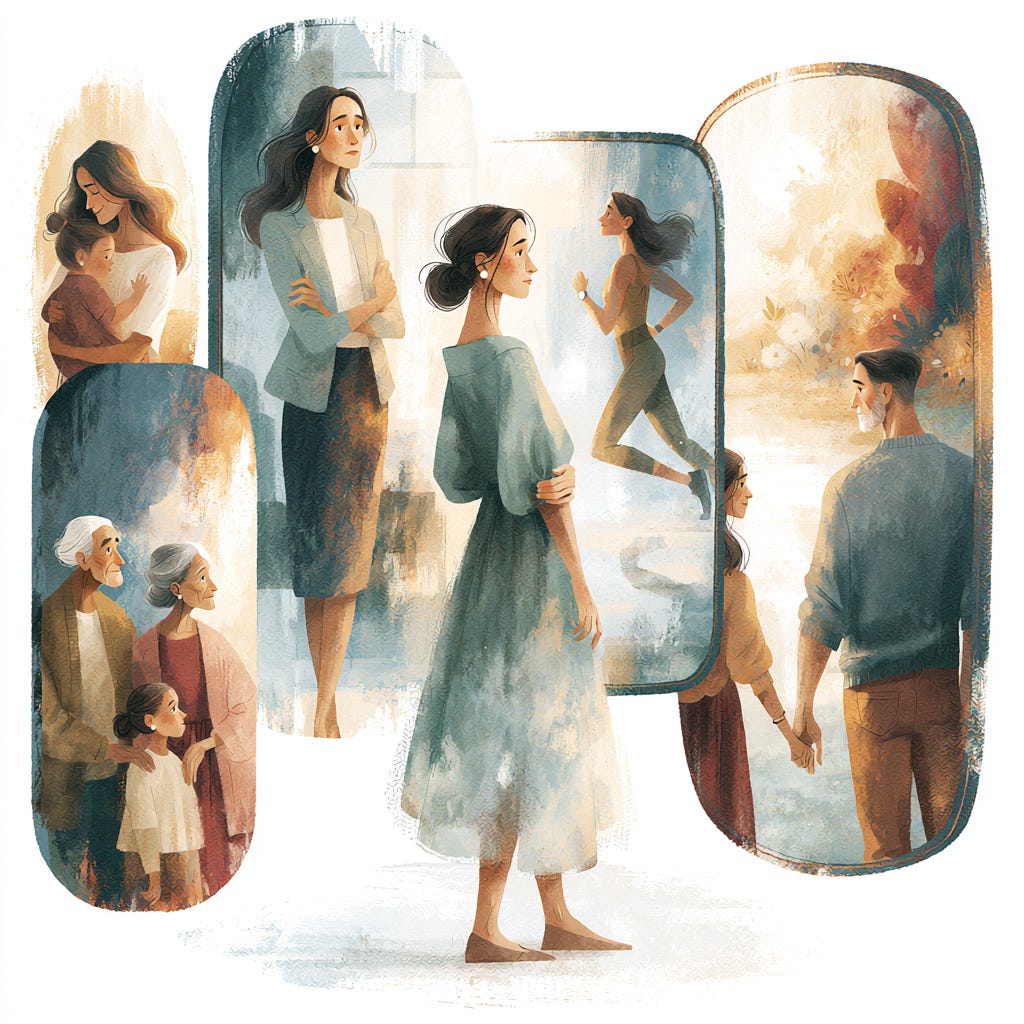
Seven and a half years ago, I moved to Australia after almost a decade of running a successful leadership development business in my birth country, Romania. I came to do my PhD, pursuing questions about adult learning that had preoccupied me most of my adult life, questions that I was obsessively passionate about and which had been the ground upon which I had built my work and my company for years.
I was ready to let go of work for a while, to just pursue my curiosity and the research. I was ready to go on an adventure with my life partner and our little girl. We had prepared for a whole year before the move, saving, considering all contingencies, making sure we had the luxury of a slow start in our new lives. There was no huge pressure, just one big blue sky of possibility.
I bet you can already guess where this is going, and you bet it’s going to get worse before it gets any better. My research questions were all about how adults grow and transform, how our meaning-making shifts as life throws challenges at us, and it was not lost on me that I set out to study transformation while leaving behind my whole known world and stepping into a new life at the other end of the Earth.
I distinctly remember a conversation with a dear friend, who is also a psychotherapist, about the unavoidable hit my identity was going to take in this new life, and me telling her, “I’ve been working on myself for years and years. I’m in a good place if such a place even exists. I’ll miss my clients and my work, but I don’t need as much external validation as I used to. I trust my self-worth with or without the business. I think I’ll survive a few years of just being a student.”
It took 3 months post-move before the naivete of that self-assuredness struck home. For the first time in my adult life, I was not working, not making any money, not building anything, not getting any positive feedback - since my early research steps were slow and clumsy and confused and confusing and not even my super generous supervisor could tell me more than - ‘trust the process, you’ll start seeing progress soon’.
Suddenly, I was no longer a successful facilitator, no longer an expert in my field, no longer a business owner, no longer financially independent, no longer comfortably navigating a known place, full of known contacts and people who appreciated me. The loss of all these props of my identity felt like being stuck in a hurricane with no cover in sight.
On top of all that, my small family was in disarray. Our precocious, hyper-social, almost 4-year-old found herself in a school where she could not speak the language, could not make herself understood, nor could she understand anyone, and her grief at the loss of her friends and her home turned into daily tantrums the likes of which we had never known - hail on top of my hurricane. I was no longer a good mother either - she told me so every evening, between tears.
Through all of this, my beloved partner, who had weathered many storms with me before, also lost his grounding. We’d never been struck by such gale-force winds at the same time before. We’d always been each other’s shelter - but now there was no place to hide and not much left of our sturdy prior Selves to cling to. To this day, we are both in awe that our relationship survived our first year in Australia - a testament to the healing power of love if there ever was one.
As I reckoned with the loss of so many pillars of my identity, all at the same time, I realised the true depth of this question: Who would you be without… that? I realised I could more easily live without some parts of my prior identity than without others. A year on, I decided to start working part-time alongside my PhD, and that sense of groundedness in familiar work was enough to lift me off the rock bottom. Our kid learned English and made new friends, and slowly, I could recover my ‘good mother’ identity too.
Some parts of my old Self never came back. I never recovered a particular sense of certainty about how things are or what they ought to be, a propensity to make assumptions and reach quick conclusions that I used to hold with quite a bit of conviction. I am much less certain about things than I used to be and believe myself better for it.
I also never quite got back my identity as a wholly independent person who doesn’t need anyone to be fully happy. I used to be terrified of being dependent on others, for anything - a result of my upbringing in a cultural context where self-reliance was seen as a fundamental survival condition. But through my first years in a new country, strangers gave me priceless gifts of mentoring and support and taught me that being ‘being with’ may just be more worthwhile than ‘being without’. Now I lean on people for so many things - both at work and at home - and feel richer for it in a way I’d never imagined possible for someone like me.
The collapse of my many identities made room for a new Self that feels in some ways more fluid than my previous one. I’m more prone to doing things that used to be ‘out of character’ - like writing fiction. More likely to daydream or read a good book when I’m supposed to be working and feeling less guilty about it. More willing to let go of control and let others take the lead on things that used to feel like ‘my job’. More aware of how many Selves actually reside in this one meat suit carrying me through life, and much less attached to any one of them being my ‘true Self’.
Recently, in a workshop with a group of leaders in a year-long executive program, I heard a couple of people talking about the discombobulating experience of starting their own business after having decades of running successful corporate careers. I felt their excitement, their fear, their curiosity and their grief - who am I if I’m not this successful executive anymore? Who am I without the organisational structures that have both confined and supported me? Who am I without the teams I’ve relied on for so long? Who am I without the public validation that comes with being in prominent leadership positions?
I also heard someone talk about their identity shift from being driven by their work as the hallmark of identity to discovering the joys of a slower life, less glamorous, less busy, with less travel and more space for the quiet of family life. They welcomed the change, yet still struggled with dilemmas around the new shape of their life and who they wanted to be in this new chapter. Who am I without my prior ‘success’? Who am I without the ‘busyness’?
I’ve heard people describe themselves as ‘doers’ and laughing nervously when asked who they would be if they stopped ‘doing’. “I’ll never stop ‘doing’” someone said. “I thought so too, until my burnout”, someone else quipped, smiling sheepishly. Who are you when you become a ‘doer’ whose body decides that you cannot ‘do’ anymore?
I wonder if it’s the times we’re in. AI, war, energy worries, climate change - this sort of collective restlessness that pumps angst into our mental space - that’s making more and more of us question our roles, the things we’ve always taken for granted. It sometimes feels to me that we live through a dark time, but also a wonderful time. On any given day, you’ll likely see a glimpse of the best and worst of humanity, depending on where you look. And you keep being nudged to reflect - who do I want to be in this day and age?
There are few things more developmental than holding our identity as ‘object’ in front of us - to be observed, gently questioned, and perhaps unravelled to then be shaped into new forms. I wonder, if you, too, have gone through such remoulding, what did you learn about yourself? What of you was left in the ego-skins you shed, and what was preserved or reimagined as new layers, new shapes and forms your Self has taken? How did you deal with the grief? What have you celebrated on the other side of it?

Dive deeper
I hope you’ve enjoyed this article. If you are curious to dive more deeply into learning about Vertical Development and how it might impact your work and life, check out our online library of webinars and certification programs accredited by the International Coaching Federation. If you choose to become a paid subscriber to this Substack, you will receive complimentary access to all our webinars and a 50% discount on our long-form online programs, including our “Vertical Development Practices for Coaches”.
Our brand new VDI babies are now out in the world! Check them out and let me know what you think!
One is the AI Developmental Lab - the first AI companion with vertical development at the core for coaches, learning designers and leaders.
The other is the Group Deliberation Inventory GDI® - the first tool to measure how a team reasons together through a complex problem in real time, applying a vertical development lens and using AI alongside psychometrics and human facilitators to gain insights into the group dynamics. Pilot workshops are taking place now - bring your team along and let’s learn together (more details on the GDI® main page)!
Spread the word…
If you want to do your bit to build a wiser, more conscious world, I hope you share this article with others who could benefit from the learning.
And, if you haven’t done it yet, subscribe!
Join your nerdy community, and let’s keep on staying curious and learning from each other.
Vertical Development: How Grown-ups Grow Up is a reader-supported publication. To receive new posts and support my work, consider becoming a free or paid subscriber.
Hi Alis, Thank you for your thought-provoking articles. I just wanted to let you know that the VDI Developmental Lab is my new favorite tool! I’ve used it both for workshop design and to receive developmental feedback on coaching sessions and it has been incredibly helpful (and challenging…in a good way).