


One of the first activities I invite participants to do in the coach training program I run is to think of a mentor who positively impacted their lives. What did that person do, exactly? How did they, the mentees, feel in relation to their mentor? And how did they transform as a result of that relationship?
Hundreds of people have answered these questions over the past decade, and there are some consistent themes coming out of their reflections.
Great mentors act as if we matter. They genuinely have our best interests at heart and show it by making time for us, listening deeply, and asking lots of questions to help us think and reflect. They truly see us, and they also see potential in us that we don’t even know is there until they point it out and encourage us to actualise it. They teach when we need it, but don’t expect us to follow their advice to the letter, as they know we have to carve our own path. In fact, they actively encourage us to do so - to push back, to question, to find our voice, even when our voice might inconvenience them.
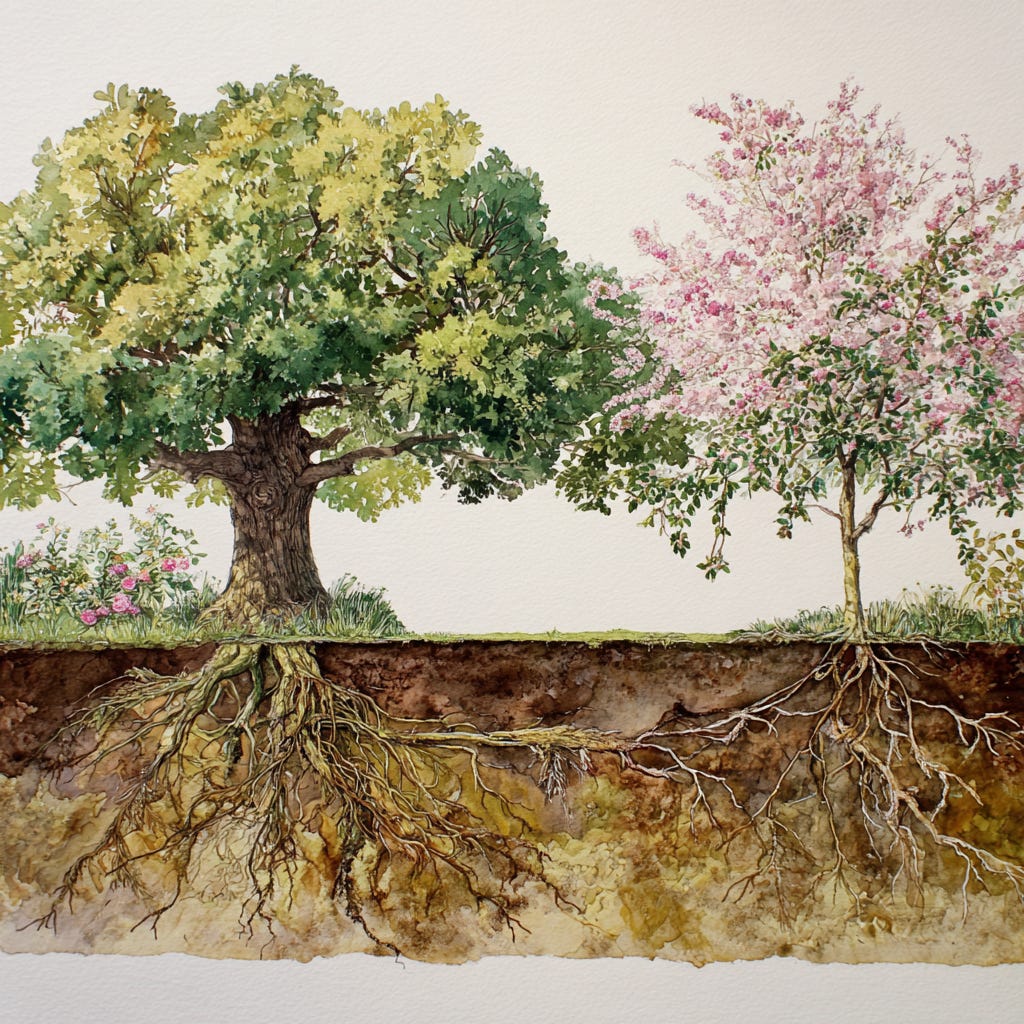
Great mentors don’t expect us to place them on a pedestal - in fact, they actively tear down the pedestal themselves, inviting us to relate to them as equals. Their sense of self-worth does not lie in us making ourselves small so they can feel big. They teach us what they know, and they are not afraid to learn from us in turn. They do not feel threatened by us; in fact, they celebrate our achievements when they reach or surpass their own. They want us to succeed.
Great mentors don’t coddle us. They challenge and support us in equal measure. There is no hiding from a great mentor. They will see right through you, call out your BS if need be, and do so with unconditional love and care for you as a human being. Great mentors are rarely (if ever) destructively critical. They are honest; they might be blunt. They will surely make us uncomfortable and feel the burden of trying to live up to the best version of ourselves they already see in us. But they are not toxic. And they never put us down.
People share, just as I have experienced in my own mentoring relationships, that you should feel safe with a good mentor. Heard. Seen. Cared for. Stretched and challenged. But never humiliated or afraid. These people make us curious; they make us want to push our limits; they hold our hand when we are terrified to try something new and trust that we can do it anyway, so much so that we, too, start to trust ourselves a little bit more.
And, before we know it, we start to change. We do stand a little taller. We do believe in ourselves a bit more fiercely. We find the courage to do hard things that scare us, knowing someone has our back. We allow ourselves to be authentic, knowing we are accepted as we are, warts and all. We learn to trust and lean in because we are given a safe space to explore. We build tolerance for mistakes, resilience, and patience, and try and try again until we make it because someone believes in us enough not to let us give up.
I have had a handful of such mentors in my life, and they have changed me for the better. My grandmother, who always put down whatever she was doing when I entered her room, giving me her full and undivided attention. She never gave advice, but always asked me: “And what do you want to do next?” My PhD supervisor, who said to me, “You are the expert in your topic. I am here to learn from you as much as I am here to teach you how to do good research. So let’s learn together.” Bill Torbert, who said, in our first one-on-one Zoom, when I tried to cut to the chase and shorten the introductions lest I waste his time: “I always have time for story. In fact, your story is more important than any research we might talk about, for that’s where your intellectual interests and passions are born. So tell me - who are you? What do you care about and why?”
My own experience is that such mentors, those who truly embody the full breadth of the developmental spirit in this role, are not the norm.
More often than not, people in a position to teach anything to anyone will expect a particular power dynamic to remain in place. The learner learns. The teacher teaches. The learner doesn’t know. The teacher does. Learning in that way is very much a one-sided process - the mentor downloads their knowledge and experience, and the mentee is always on the receiving end.
When the mentee’s cup is full, and they start forming their own opinions about the subject at hand, there’s often a rupture with the mentor. Wise mentors facilitate this rupture by ‘cutting loose’ their mentee progressively, over months and years. They teach, and they let go. But mentors who draw their sense of self-worth from the pool of their own knowledge don’t really like to see other people’s pools get fuller.
History is rife with such break-ups. Freud and Jung. Freud and Adler. Freud and Otto Rank. Freud and Sándor Ferenczi. Freud clearly did not like it when his students, having become masters in their own right, began to disagree with him. Humphry Davy and Michael Faraday. Rodin and Camille Claudel. Edison and Tesla. Our own vertical development field is rife with stories of mentoring relationships gone sour, partnerships unravelling, and people getting entrenched in their own theories while dismissing others’.
As a mentor, letting your mentees follow their own path, particularly when it challenges your own, is likely the most developmentally challenging thing you might do. Shifting roles to become the student when you have long been the teacher. Turning from a guide into a partner. This is likely the same as the fundamental unravelling we, parents, have to go through as our children become grown-ups in their own right and start making life choices that diverge from our own. To continue supporting them, being a safe harbour for them, while honouring their differences. That is wisdom. And it’s hard!
The gifts and perils of mentoring are very much on my mind as I find myself being pulled into more of a mentoring role across more contexts. I am acutely and painfully aware of the huge responsibility that comes with this role. I notice how attached I can get to my way of doing things, and how much effort it takes to let go of what I think I know and hold space for the people I work with to do it their own way. I notice that I need to intentionally step back from my own certainties, constantly invite feedback from those I lead or hold learning spaces for, encourage them to push back, and actively challenge me, just as I challenge them.
I was recently a student in a course where the teacher had very clear ideas about what we were meant to learn and how, and little tolerance for anyone with any prior knowledge on the topic. They needed their students to act like blank slates, follow the instructions and comply. While extolling the importance of flexibility in learning, they expected everyone to learn in the same way, at the same pace. While asking people to share their opinions openly, they dismissed those they disagreed with. While discussing the virtues of curiosity and kindness, they offered harsh, evaluative feedback rife with unchecked assumptions and blunt judgments.
In turn, I found myself railing against the rigidity and what I perceived as a stark dissonance between the theory and the practice. I noticed myself getting frustrated and becoming ‘difficult’ by pushing back even when no push-back was necessary. I found myself becoming rigid and judgmental in turn, all while feeling victimised and wallowing in a feeling of righteous indignation. I noticed myself becoming the teacher I was railing against. It was a painful, profoundly humbling, and valuable experience, and for me, a stark reminder of how easy it is to become blind to one's own ego and miss the moment when you have stopped walking your own talk.
Such experiences are a sobering reminder that my own ego is never just in the rearview mirror. It is too easy to get triggered, to fall out of alignment with my deepest values, to fill myself with a sense of self-importance, certainty, and righteousness, and to lie to myself that I am curious when, in fact, all I am is condescending.
The power dynamics of teacher/student, mentor/mentee or leader/team member often create the most fertile ground for such mutual self-deceit. You think you are being your best self, and the other person just isn’t getting it, when in fact you’ve long stopped walking your talk, just like they have stopped walking theirs.
In our own field of adult development, such self-monitoring feels to me like a crucial condition for any good work to get done. You simply cannot be a good developmental facilitator for others if you are not constantly on the lookout for your own developmental edges.
Where might you be wrong? What are you blind to? What can this person, who just pushed all of your buttons and made you see red, teach you about yourself? What is it that you are truly responding to when you think you are reacting to them? How do you know when it’s time to stay ‘stop’ to an abusive behaviour, versus when you are just feeling triggered because you see something in the other that you’ve failed to examine in yourself?
In the coaching program, we have this mantra: “You have the clients/teams/kids you need.” That is, in supporting another from any role - mentor, leader, parent - you are bound to be faced with your own rough edges and blind spots. Your mentees are bound to place a mirror in front of you, where you will see all your unexamined flaws, fears and limitations. They will present you with dilemmas you have not resolved yourself. The problems they are struggling with are problems you are struggling with too, and you will have to accept that you don’t know the answer and yet still be there for them as they seek theirs.
Bottom line, being a good mentor/coach/facilitator/leader/parent is hard, constant work. Being a jerk, by contrast, takes no effort at all (in fact, it’s quite freeing and perhaps even perversely pleasant in the moment). The world needs more of us to lean into that kind of hard work right now. As a good friend of mine loves to say: “To make the world a better place, all you’ve got to do is not be a jerk”.
Easier said than done. To do that, first you need to acknowledge that you are fully capable of being a jerk in the first place. You also have to accept that, however wise you might strive to be, that ego-driven side of you is there, waiting to make its appearance and pound its fist on the table whenever we stop paying attention. With that honesty starts the hard work of walking the talk over and over and over.
I’m wondering where in your life do you need to do that work right now? What do you notice if you examine your own congruence to the values you care about? And who in your life is in a position to place a clear mirror in front of you when you go astray?

Dive deeper
I hope you’ve enjoyed this article. If you are curious to dive more deeply into learning about Vertical Development and how it might impact your work and life, check out our online library of webinars and certification programs accredited by the International Coaching Federation. If you choose to become a paid subscriber to this Substack, you will receive complimentary access to all our webinars and a 50% discount on our long-form online programs, including our “Vertical Development Practices for Coaches”.
If you are seeking to train as a developmental coach and get your first ICF credential, check out our ICF Level 1 Foundation Diploma in Developmental Coaching - next cohort starts in July 2026 (running on Americas/Apac time zones). We only have a handful of places left. Check out the Program Page for details, and reach out to schedule an interview.
Spread the word…
If you want to do your bit to build a wiser, more conscious world, I hope you share this article with others who could benefit from the learning.
And, if you haven’t done it yet, subscribe!
Join your nerdy community, and let’s keep on staying curious and learning from each other.
I love this exercise so much - over the years I've seen it to be universally true; the everlasting and reverberating impact that one or two kind and dedicated mentors (silent, adopted or organised) can have. It is deeply touching to pause in a moment of gratitude - thank you for the reminder - and thank you to Mr Brown - my maths teacher in year 12 - I carry your kindness and care with me to this day.
I read this and thought about something that took me a decade to see.
My mentor didn't do any of the things usually associated with "good mentoring". He didn't give me a map. He didn't accelerate my decisions. When I came with "what should I do?", he once suggested throwing a dice on a world map to check whether the place it landed on would resonate with me. If not, I could throw again.
At the time it felt a little... non-literal. A decade later I understood that was the method. He wasn't running the process just holding the space stable enough for me to see my own structure.
You write that great mentors see potential we don't yet see in ourselves. I agree. But I think there's something even harder than seeing - it's not closing what the mentee isn't ready to close yet. A responsible mentor recognises the moment when the absence of an answer is more developmental than the answer itself.
The hardest form of support is sometimes non-interference.